
Let’s imagine for a moment that you are planning a road trip. To make it happen, you need a car (infrastructure), fuel (energy), and a route to follow (network). Now, every mile you drive leaves a trail of emissions—your "road trip carbon footprint."
The world of IT operates in a similar way, leaving its own digital footprint behind. Let me take you on a journey to understand the carbon footprint of IT—whether for tech organizations, non-tech organizations, or even the cloud and software solutions we use every day, through below 5 points.
1. The Carbon Footprint of an IT Organization
Imagine a massive power plant that generates electricity for an entire city. It’s always running, consuming vast amounts of fuel and producing emissions as a byproduct. In the IT world, this power plant represents data centers, the energy-intensive hubs that store, process, and deliver all the information we rely on.
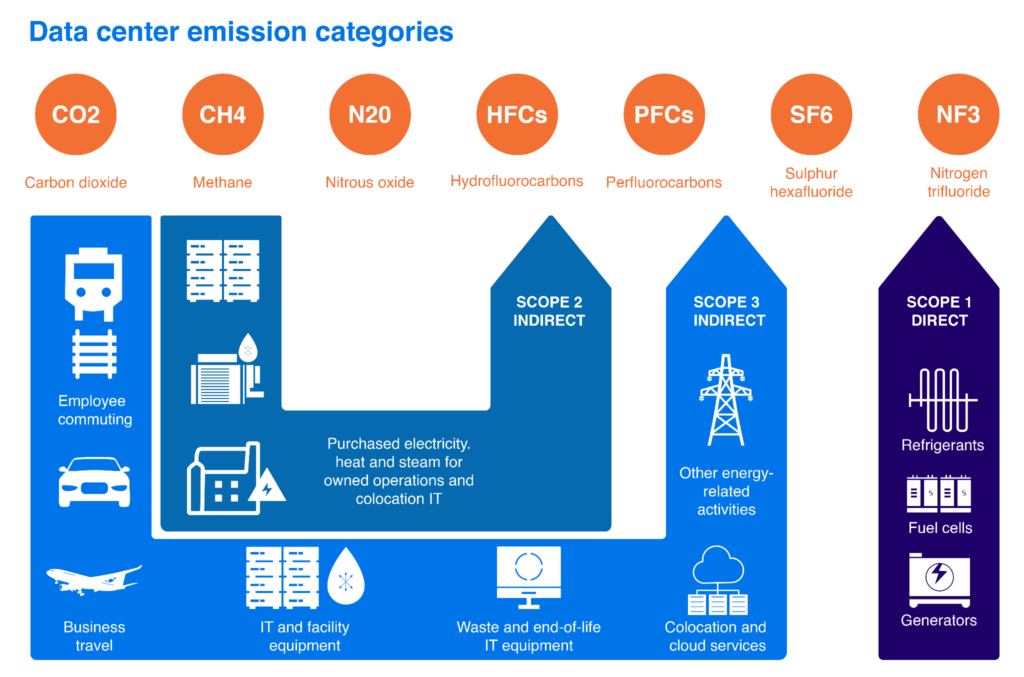
The carbon footprint of an IT organization consists of three key "power sources," aligned with the global framework of Scope 1, 2, and 3 emissions:
Scope 1: Direct emissions from data centers—imagine the exhaust from the power plant’s smokestacks. If a company operates its own data centers, emissions from on-site fuel use (e.g., diesel for backup generators or natural gas for cooling systems) fall under this category.
Scope 2: Indirect emissions from electricity use—this is the fuel burned elsewhere to generate electricity for running servers, cooling systems, and offices.
Scope 3: Broader emissions—these cover everything else, like the emissions from manufacturing servers, transporting equipment, employee travel, and even the impact of third-party vendors.
In short, an IT organization’s carbon footprint is the sum of all these emissions, forming the foundation of sustainability efforts in IT.
2. IT Estate in a Non-IT Organization: A Part of the Bigger Picture
Now, let’s move to non-IT organizations. Imagine a bank, retailer, or healthcare provider—they aren’t IT companies, but they still rely heavily on IT systems. For example, a clothing retailer might use IT for managing inventory, running their website, and supporting logistics. This is where their IT estate comes into play.
The IT estate is a slice of the organization’s broader carbon footprint, consisting of:
In-house IT infrastructure like servers.
Outsourced cloud services or third-party IT solutions.
Devices like laptops and networking equipment.
This IT carbon footprint feeds into the organization’s overall carbon footprint, making it essential to quantify and mitigate emissions in this area to achieve broader sustainability goals. This also connects to the IT organization’s carbon footprint (1) because non-IT companies often depend on IT providers, contributing to their Scope 3 emissions. For example, the carbon emissions from a retailer’s website are linked to the energy consumption of cloud servers provided by an IT company.
3. Carbon Footprint Associated with Cloud Usage
Let’s talk about cloud computing, which has revolutionized IT. The cloud is like a public transportation system. Instead of owning and maintaining your own car (or IT infrastructure), you pay to hop on a bus or train that takes you where you need to go.
When you use cloud services, the carbon footprint is twofold:
Operational emissions: The energy required to run the cloud data centers during your usage.
Embodied emissions: The emissions from manufacturing the servers, cooling systems, and network devices used in the cloud.
How it connects:
For IT providers (e.g., AWS, Microsoft Azure), the cloud infrastructure falls under their Scope 1 and 2 emissions.
For non-IT companies, using the cloud adds to their Scope 3 emissions.
Cloud services are also intertwined with product carbon footprints, as any software or website hosted on the cloud inherits a share of the emissions from running the infrastructure.
4. Software Carbon Intensity (SCI)
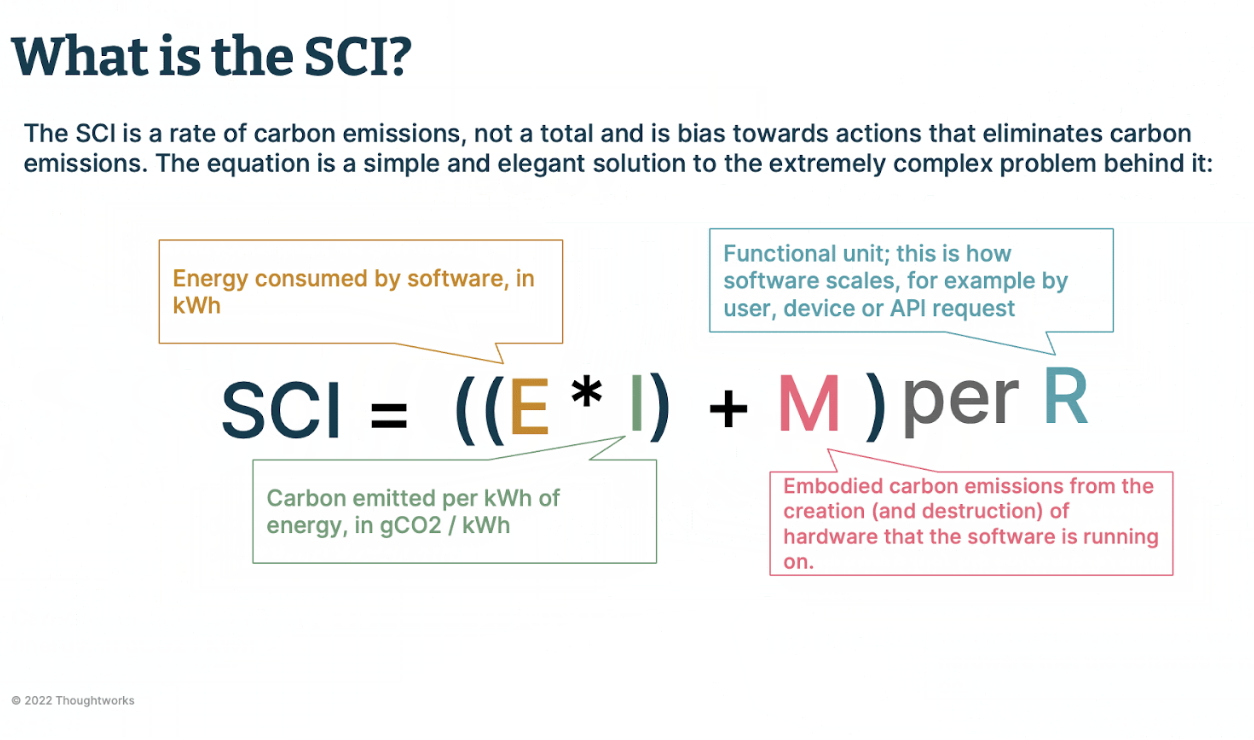
Every software solution has measurable carbon emissions across its lifecycle—development, deployment, and usage. This is known as Software Carbon Intensity (SCI).
For example, if a company develops a SaaS (Software as a Service) product like a project management tool, its carbon footprint includes the energy consumed by servers, networks, and user devices when running the software.
Components of SCI include:
Energy Consumption: Electricity used during software operation.
Carbon Intensity of Electricity: Emissions per kWh of energy consumed.
Hardware Efficiency: Efficiency of devices running the software.
Usage Impact: How and how much the software is used.
SCI allows organizations to measure and optimise the emissions of individual software products including mobile apps, enterprise software, APIs, cloud-based platforms, etc.
5. Website Carbon Footprint
A website is often the most visible part of an organization’s digital presence, but it’s also tied to the rest of the IT ecosystem. The carbon footprint of a website includes:
Scope 1 and 2 emissions of the servers and data centers hosting it.
Scope 3 emissions from user devices and network traffic.
Key components include:
Data Transfer: Amount of data sent to and from a website’s server.
Energy Use in Hosting: Power consumed by the data center hosting the website.
Device Energy: The energy required by user devices to load and interact with the site.
Network Energy: Energy used for data transfer across networks.
Websites and software solutions connect because they both share the same underlying infrastructure. The carbon emissions of a company’s e-commerce site, for instance, overlap with its broader IT estate, cloud usage, and software systems.
The Bigger Picture: How It All Connects
The beauty of this journey lies in seeing how everything ties together:
The IT organization’s carbon footprint provides the foundational Scope 1, 2, and 3 framework.
The IT estate in a non-IT organization is a smaller piece, reliant on IT providers and contributing to their Scope 3 emissions.
Cloud usage underpins software and websites, adding both operational and embodied emissions.
Software and websites inherit emissions from the cloud, networks, and user devices, making them part of the product’s carbon footprint.
Each level builds on the last, much like branches growing from a single tree trunk. Together, they highlight how interconnected the carbon footprint of IT is, showing that addressing one area—like optimising software—can ripple across the entire ecosystem.
The Path to Sustainability
By understanding and addressing the carbon footprint at every level—organization, IT estate, cloud, software, and websites—we can make significant strides in reducing emissions. Small changes, such as optimising energy efficiency or choosing greener cloud providers, can have a cascading impact across the IT ecosystem.